
9 Sensory-Friendly Airport Prep Steps for Families
Airport days are full of small transitions: parking or drop-off, check-in, security, a long terminal walk, boarding, and the noise of a crowded cabin. For a child who is sensitive to sound, light, uncertainty, or crowded spaces, those transitions can take more energy than the flight itself. The goal of preparation is not to make every moment perfectly quiet. It is to reduce avoidable surprises, give your child choices where possible, and know what the next step will be.
These nine preparation steps are designed for families traveling with sensory-sensitive children, including autistic children and children who simply find airports overwhelming. Every child’s needs differ, and airport services vary by location, airline, and date. Check the airport and airline’s current accessibility information, speak with your child about what helps, and use professional advice when you need it. A flexible plan should include a quieter option, a familiar comfort item, and permission to change the pace.
9 sensory-friendly airport preparation steps
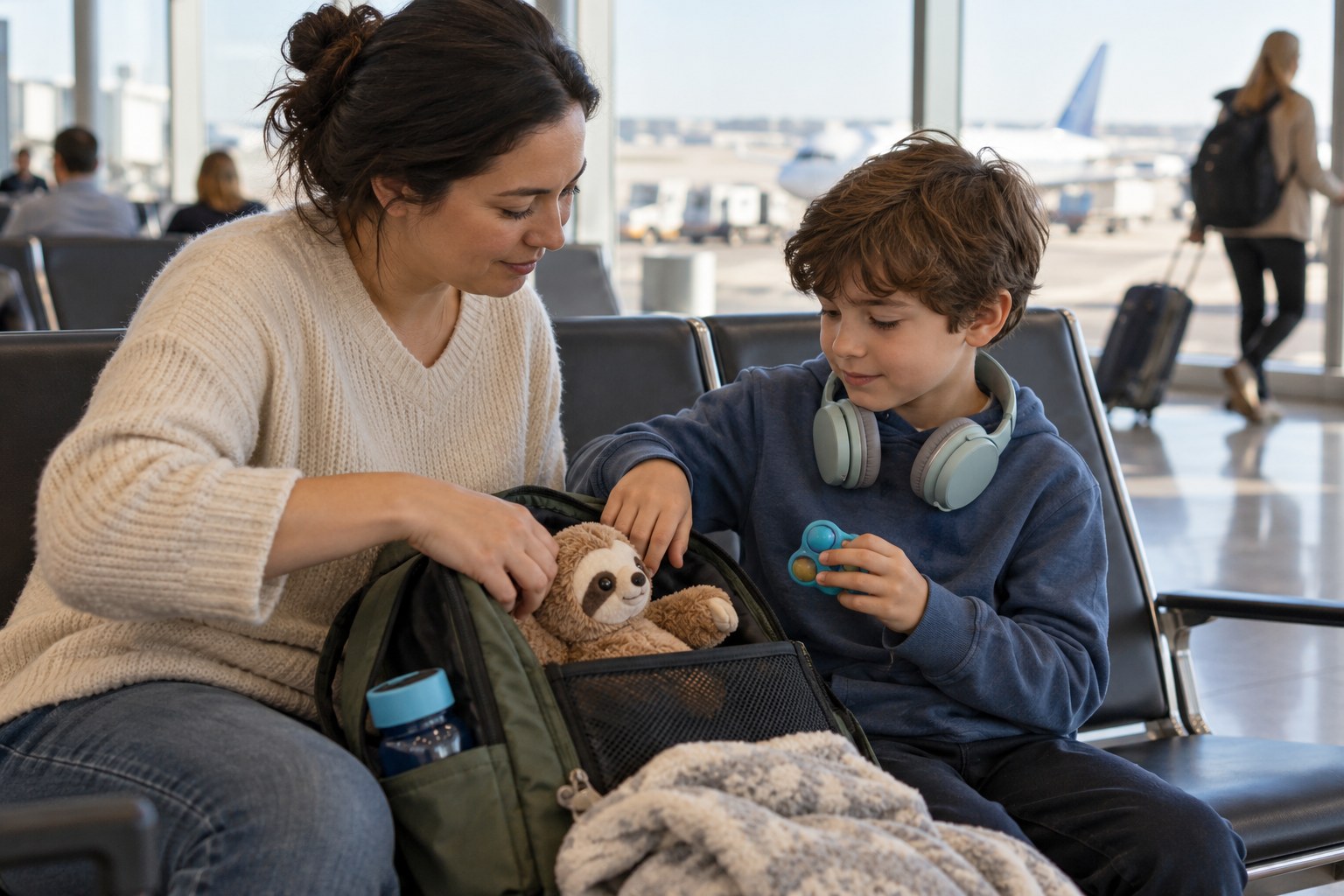
1. Ask your child what feels hardest
Start with a conversation that fits your child’s age and communication style. The most difficult part may be the security line, announcements, an unfamiliar restroom, separation from a caregiver, crowded boarding, or the feeling of not knowing when the wait will end. Ask what they would like to bring and what kind of help they want if they begin to feel overloaded. Some children prefer reminders; others want fewer questions. You do not need to predict every challenge. Knowing the two or three biggest stress points gives you a useful starting map.
2. Make a simple visual sequence
Create a short itinerary using photos, icons, written steps, or a small set of cards: arrive, check in, security, find the gate, board, fly, arrive. Keep the sequence honest. If you do not know whether you will take a shuttle or walk to the terminal, show both as possibilities and explain that the airport will determine the route. Include a step for waiting and a step for asking for help. A visual plan is most useful when it is brief enough to review without becoming another demand.
Use realistic language rather than promising exact timings. You might say, “After security we will find the gate. We may wait there, and I will tell you when boarding begins.” If the flight changes, cross out or update the step with your child rather than pretending the original plan still applies. A small dry-erase card or a phone note can make changes visible. When a child knows the next step and who is staying with them, uncertainty often becomes easier to manage even when the airport is busy.
3. Preview the airport and airline procedures
Visit the airport and airline accessibility pages before travel and look for details relevant to your family: terminal maps, sensory rooms, quiet areas, family restrooms, mobility assistance, assistance animal rules, and the process for requesting help. Confirm the airline’s procedures for seating, preboarding, carry-on items, and any support your child needs. Policies can change, and a webpage may not answer a specific question, so contact the airport or carrier directly. Keep the answer, date, and contact name in a note you can retrieve on travel day.
Consider whether a practice visit, airport tour, or school-age familiarization program is offered locally. Availability varies, and a tour may not reproduce the actual crowd or security process. A home rehearsal can still help: pack the comfort kit, walk through a pretend security check, and practice placing items in a tray if that is likely to happen. Avoid making the rehearsal a test of compliance. Let your child pause, ask questions, and learn the sequence at a pace that works for them.
4. Decide how much airport time is right for your family
Arriving early can reduce the fear of missing a flight, but an excessively long wait in a stimulating terminal may make the day harder. Check the airline’s arrival guidance, the airport’s current procedures, and the time needed for your own check-in, assistance, and security. Then consider what your child can comfortably manage. If the airport has a quieter place after security, you may prefer to complete necessary steps and then move there. If waiting is the hardest part, plan a calm activity and a clear way to track boarding.
Build in enough time for a restroom break, a snack, and unexpected changes, but do not invent a guarantee that security will take a particular number of minutes. Tell your child what you know and what remains uncertain. If you have requested a service or accommodation, reconfirm how to access it on arrival. A schedule with a buffer and a plan for a delay is more reassuring than a minute-by-minute promise that the airport cannot keep.
5. Pack a small comfort and communication kit
Choose a few familiar items your child already uses: noise-reducing headphones or ear defenders, sunglasses or a cap, a small fidget, a favorite book, a soft item, or a device with downloaded media. Include chargers, but keep the kit compact and easy to reach. Pack a snack or drink only after checking current security rules and the airline’s requirements; do not assume an item can pass through screening. If your child uses a communication card, device, or written script, keep it accessible rather than in checked luggage.
The best kit is tailored rather than extensive. Too many choices can be tiring, and a new gadget may not feel comforting in a crowded terminal. Involve your child in selecting the items and decide how to carry them so they are not misplaced during security. Keep one backup comfort item with an adult if that is useful. Consider labeling belongings with a caregiver phone number while protecting personal information as you prefer. Your child should know where the kit is and how to ask for it.
6. Plan a respectful security-screening approach
Security screening can involve instructions, trays, changes to clothing or belongings, and separation from the usual routine. Before the trip, review the relevant airport security authority’s current guidance and ask what support is available for a child who may need extra explanation or time. Tell staff about your child’s communication needs in a concise way, and describe what helps: one instruction at a time, a caregiver staying nearby, a chance to prepare, or an alternative communication method. Procedures differ by country and can change, so do not rely on an old social media post.
Practice a simple phrase your child can use, such as “Please explain what happens next,” or agree that you will speak for them when needed. If a preferred item must be screened, have a backup plan for the brief separation. Explain the sequence honestly: staff may ask to inspect a bag or device; the exact process depends on current rules. If your child becomes overwhelmed, remain calm and ask staff how to proceed safely. The point is to prepare, not to promise that screening will be quick or identical to practice.
7. Find the reset point after security
Before travel day, check the terminal map for seating, family restrooms, quieter corners, sensory spaces, and the route to your gate. On arrival, find one reset point your child can recognize, such as a particular seating area or a landmark near the gate. Do not assume a room labeled quiet is open, available, or appropriate for every child. Ask staff about current access and crowding, and choose a backup spot in case the first is occupied. A dependable place to pause can help restore a sense of control after a noisy transition.
Give the child a choice when possible: sit with headphones, walk briefly with an adult, use the restroom, or have a snack. Avoid placing the reset point so far from the gate that you create another stressful rush. If you have a tight connection, ask the airline about the actual distance and whether assistance is available. Each airport’s layout is different, and map estimates may not reflect queues or construction. Check again with staff once you are inside.
8. Make boarding and seat transitions predictable
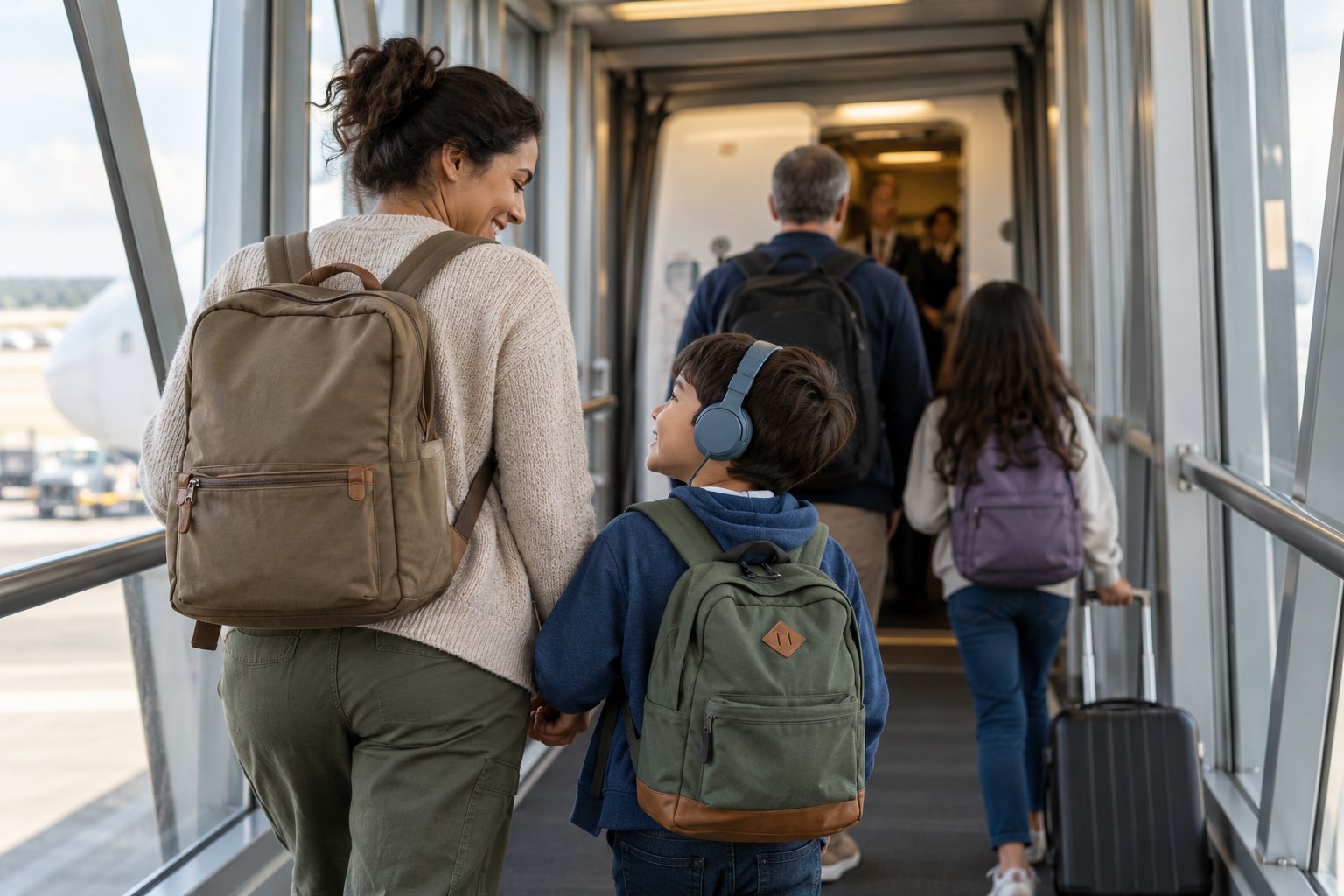
Boarding often brings an announcement, a queue, a narrow jet bridge, and a change from spacious terminal to a crowded cabin. Explain the sequence in advance: when the group is called, where you will line up, and where your child’s comfort kit will be. Ask the airline about preboarding or family boarding if that would help, and verify how it works for your flight. Some families prefer boarding early to settle; others prefer to wait until the line clears. The right choice depends on the child, the aircraft, and the amount of time seated before departure.
Show your child the seat assignment and let them help choose a small item to keep close. If you need to move seats or request an accommodation, contact the airline before travel and confirm at the airport. Avoid promising that a seat change will be granted. When possible, agree on a simple plan if your child needs a break from conversation, light, or touch. Explain which items must be stowed for takeoff and which can remain available, following the crew’s instructions.
9. Prepare a plan for overload or a flight change
Even careful preparation cannot eliminate noise, delays, crowds, or unexpected announcements. Agree on one phrase or signal your child can use to say “I need a break,” “too loud,” or “I don’t understand.” Decide what an adult will do first: move to a quieter spot if safe, reduce questions, offer a familiar item, or ask staff for help. The order can be simple and flexible. If the flight is delayed, update the visual sequence and explain what changed in plain language. Do not blame the child for reacting to a situation that is difficult.
For a cancellation or missed connection, keep the essential kit and contact details in a personal bag. Know how you will communicate with the airline and where you can wait while an adult handles rebooking. If your family separates briefly, choose a safe meeting point and make sure the child knows which staff member or uniformed official they may approach. Use your judgment about age and independence, and follow airport safety rules. A contingency plan is not a prediction of failure; it is a way to keep choices available if the day shifts.
A travel-day sequence you can personalize
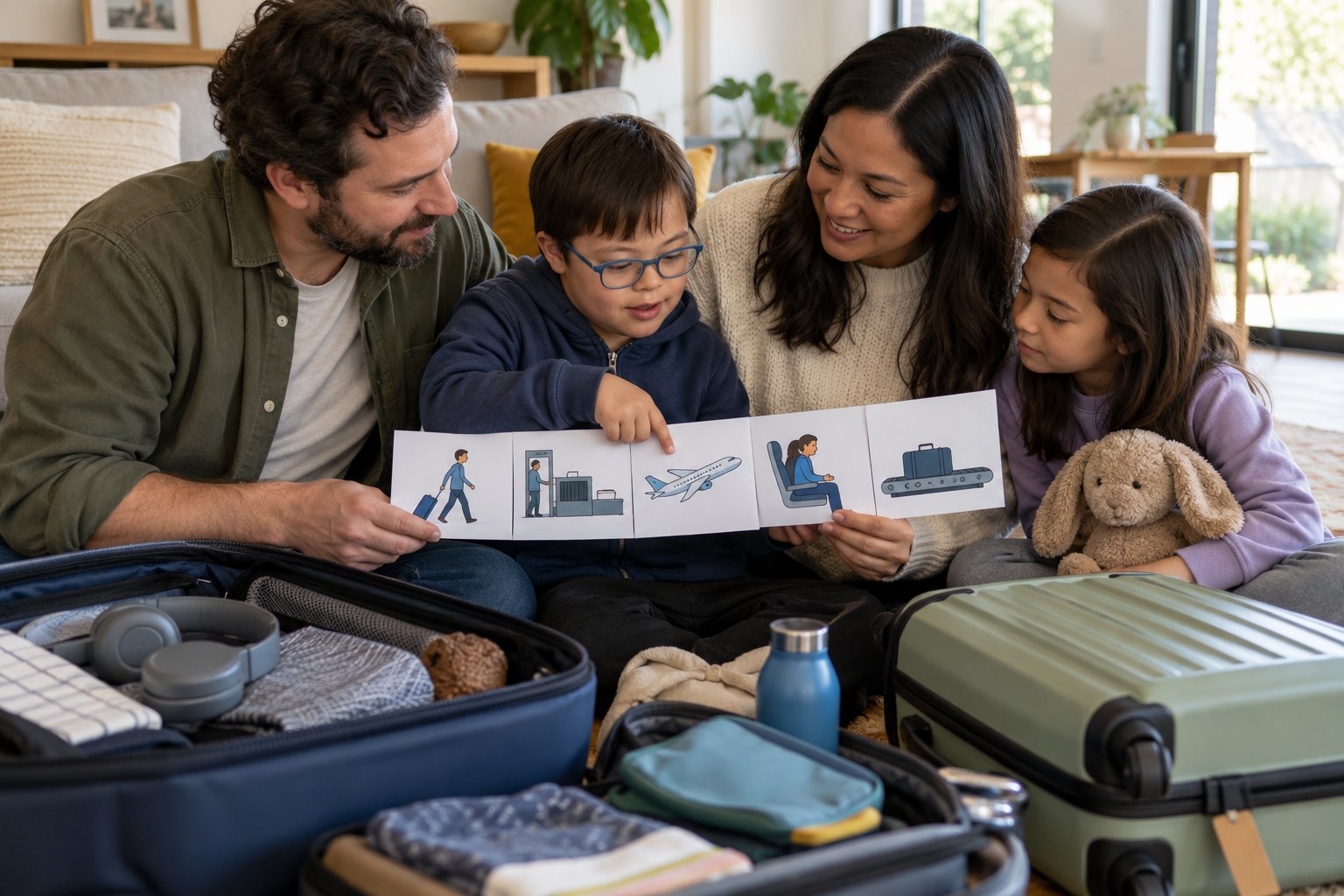
Use a short sequence that tells your child what comes next without describing every minute. For example: “We arrive and check in. Then we go through security with our bags. After that we find our gate and take a break. When boarding starts, we get on the plane and find our seats. The crew will explain what to do next.” Add only the details that help this particular child, such as the elevator, family restroom, or snack stop. Leave room for the airport to change the order.
Review the sequence at home, in the car, and after each major transition. Let your child cross off steps or move a marker as events happen. A quick check-in can be more helpful than repeatedly asking whether they are okay. Ask a concrete question: “Would headphones or a quiet seat help right now?” If the answer is no, respect it and keep the options available. Predictability comes from knowing how to move through uncertainty, not from pretending nothing unexpected will happen.
Before you leave home
- Confirm flight and terminal details with the airline.
- Check current airport and security guidance.
- Save maps, service contacts, and boarding information.
- Pack familiar sensory supports in an easy-to-reach bag.
- Agree on a phrase or signal for asking for a break.
- Identify a reset point and a backup near the gate.
- Explain that plans can change and show how you will update them.
Keep the plan centered on your child
A sensory-friendly plan is not a checklist to complete perfectly. One child may want detailed previews, while another may feel better with fewer explanations. A child who enjoys headphones at home may not want them at the gate. Watch for the child’s cues, offer support without forcing a particular tool, and make room for them to say what works. If your child has an individualized support plan, discuss travel considerations with the professionals who know them.
Prepare for the airport you will actually use, but stay ready to adapt. Keep the next step clear, protect access to familiar comforts, and give your family enough time to pause. A successful trip does not mean the airport was silent or every transition felt easy. It means your child had support, choices, and a trusted adult beside them as the day unfolded.
Sources
https://www.tsa.gov/travel/tsa-cares/disabilities-and-medical-conditions
https://www.tsa.gov/travel/tsa-cares