
18 Family Hotel Features to Compare Before You Book
A hotel can advertise a kids’ pool, family room, and free breakfast and still be a poor fit for your particular trip. The family that needs a quiet bedtime has different priorities from the one that plans to stay out late; a kitchenette matters much more on a weeklong trip than a single overnight. The useful question is not “Is this hotel family-friendly?” but “Will this room and location make our actual days easier?”
Use this comparison guide to judge family hotels by the things that change the rhythm and the real cost of a stay: sleeping setup, meal flexibility, transit, downtime, laundry, accessibility, and policies. It helps you compare a hotel with a suite, apartment-style stay, or resort without assuming that the one with the longest amenity list is automatically best.
First, define what a successful stay means for your family
Before opening booking tabs, write down the three problems your lodging must solve. If everyone needs to sleep at different times, separation matters. If your days start early, a reliable breakfast or a nearby grocery store may matter more than a spa. If your plan includes a rental car, parking and the cost of reaching the city center may be decisive. This small exercise protects you from paying for features that look good in photos but do little for your itinerary.
- Sleep: How many separate beds or sleeping zones do you need, and can anyone sleep in the living area?
- Food: Will you eat breakfast at the property, bring snacks, or prepare simple meals?
- Transport: Are you relying on walking, transit, a rental car, or hotel shuttles?
- Reset time: Does your group need a pool, playground, quiet room, or a reliable place to rest midday?
- Trip length: Will laundry, a fridge, or a kitchen become more valuable after several days?
Compare the room before the amenity list
Sleeping arrangements that work after lights-out
Room occupancy is not the same as comfortable sleeping capacity. A listing may allow four guests, but the arrangement might be one bed and a sofa bed that takes up the only sitting space. Check whether the sofa bed is full size, whether linens are included, and whether the room still has a clear path to the bathroom when it is open. For younger children, ask about cribs, bed rails, and age rules rather than assuming they are available or free.
Separate sleeping areas can be worth more than an extra square footage number. A suite with a door or a two-room setup may let adults read or prepare for the next day after children go to sleep. The trade-off is cost: compare the suite premium with the cost of two rooms, including any connecting-room guarantee. If you need adjoining rooms, get confirmation that the specific rooms connect; “nearby” is not the same thing.
Kitchenette versus full kitchen
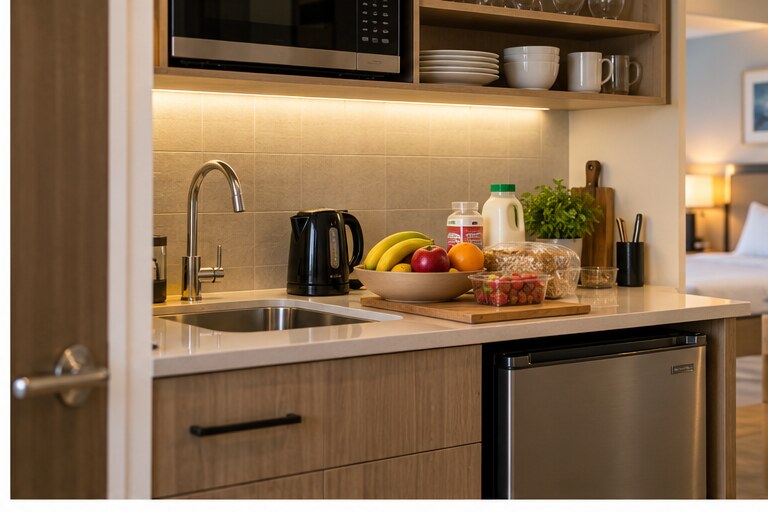
“Kitchenette” can mean a microwave and a small fridge, not a stove or dishes. For breakfast, bottles, leftovers, and simple snacks, that may be enough. For a weeklong stay or dietary needs, a cooking surface, sink, utensils, and grocery access can change the value calculation. Ask what is actually in the room and whether cookware is supplied. A kitchen only saves money if your schedule gives you time to use it.
Also check the refrigerator size and whether it is available for guest food. Some rooms have a stocked minibar or a small beverage cooler that is not intended for groceries. Families carrying medication that requires refrigeration should confirm temperature range, storage space, and backup arrangements directly with the property.
Judge the location by your daily route, not the map pin
A hotel two blocks from a landmark can still be awkward if the route includes steep hills, long crossings, limited sidewalks, or an unreliable transit connection. Put your likely morning, afternoon, and evening destinations into a map and check how you would actually get there with a tired child, stroller, mobility aid, or luggage. Consider how often the family will return to the hotel during the day. A central room can cost more, but it may pay off if you need a predictable rest stop.
When comparing a farther-out hotel, count the round-trip travel time and cost for every planned outing, not just the ride to the first attraction. A complimentary shuttle may run only at certain hours, require reservations, or serve a limited route. Confirm frequency, last return time, capacity, stroller rules, and whether it operates on the dates of your stay. “Free shuttle” is a feature to verify, not a substitute for a transport plan.
Meal plans and breakfast: compare the real routine
Breakfast included can reduce morning friction, especially when your group has an early start. But the label alone does not tell you whether the meal fits your family. Check service hours, whether weekends differ, whether children are included under the rate, what happens when you leave before breakfast opens, and whether the food options work for allergies or dietary needs. A grab-and-go bag may be helpful, but ask before relying on one.
Compare the total family cost of breakfast at the hotel with one nearby café or grocery option. If the hotel rate is higher, the premium may still be worthwhile when it saves a long morning search or gives the family a predictable start. For a group that likes to sleep late or explore local food, a paid meal plan can add cost without adding value. Look at the timetable your trip will actually follow.
Downtime features that earn their space
Pool, play area, and indoor options
A pool can turn a low-energy afternoon into a satisfying part of the trip, but check operating dates, hours, supervision rules, depth information, and whether access costs extra. If the pool is outdoor and your trip is in a cool season, it may not be usable. A splash pad or small play space can be more valuable to a toddler than a large pool; an older child may care more about a place to sit with Wi-Fi or a game room.
Ask what indoor fallback exists for rain or heat. A hotel marketed as a resort may have extensive grounds but little comfortable indoor space for a family during a weather delay. If the trip includes midday rest, a quiet room and a convenient elevator may be more useful than a long list of recreation facilities located across the property.

Laundry and a place to dry wet gear
On a short trip, a laundry room may be a backup. On a longer stay, it can change how much clothing you need to pack. Check whether machines are on site, how payment works, whether the room is open late, and how many machines serve the property. If you are visiting a beach, lake, or water park, ask about a place to dry swimsuits and towels. A washer in the building is not useful if a single machine has a long queue at the exact hours your family can use it.
Safety, accessibility, and quiet are specific questions
Photos cannot confirm the details that matter for a child or a guest with access needs. Ask about window locks, balcony access, pool barriers, stair gates, elevator access, and whether the room has a bathtub if that is essential. These features vary by property and room. Do not assume a hotel’s general accessibility statement confirms that a particular guest room will fit your equipment or provide the feature you need. Request the precise room information and keep the confirmation with your reservation.
For guests with mobility, hearing, or vision disabilities, ask the property about specific features, routes, and communication accommodations. The U.S. Department of Justice provides lodging guidance, but travelers still need property-specific information for their chosen room. A “wheelchair accessible” filter is a starting point; verify bathroom configuration, entry and interior clearances, bed height, elevator path, and any balcony or patio access that matters to you.
Noise can also shape a family stay. Ask whether a room faces a highway, courtyard, elevator, event area, or loading zone. If bedtime is early, request a room away from bars and late-night gathering spaces, then ask whether the request can be noted rather than guaranteed. Bring a backup sleep plan, but do not use it as a reason to ignore a location problem you could avoid while booking.
Read the policies and total price together
Compare the full price for the same dates, number of guests, and bed setup. Include taxes, resort or destination fees, parking, breakfast, housekeeping charges, extra-bed fees, and any deposit. A lower nightly rate can become more expensive once the features your family needs are added. Screenshot or save the final breakdown, because a booking result page may hide some fees in separate steps.
Check cancellation deadlines, deposit terms, payment timing, and the rules for changing the number of guests. If a child becomes ill, plans shift, or the family needs to leave early, a flexible rate may be worth paying for. Compare its premium with the amount you could lose under the cheaper rate. Also verify check-in time, luggage storage, and late-arrival instructions if your flight or drive could run behind schedule.
Hotel, suite, vacation rental, or resort?
There is no lodging type that wins every family trip. A conventional hotel may provide daily service, a front desk, and predictable booking policies. An extended-stay property may offer a kitchenette and laundry. A vacation rental may provide bedrooms and a kitchen, but could require a cleaning fee, a longer check-in process, or a ride from the main attractions. A resort may make downtime easy, while adding fees and encouraging you to spend much of the trip on the property.
- Choose a conventional hotel when you value a central location, reliable front-desk help, or a short stay with limited need for cooking.
- Choose a suite or extended-stay hotel when a separate sleeping area, fridge, microwave, or laundry will make multiple nights simpler.
- Consider a vacation rental when private bedrooms and a full kitchen are priorities and you have checked cleaning, service, access, and cancellation terms.
- Choose a resort-style property when the family will use its recreation facilities enough to justify the total price and time spent there.
A family hotel comparison scorecard
Compare no more than three finalist properties at a time. Give each a simple score from 1 (poor fit) to 5 (excellent fit) for your family. Weight your top priorities twice: if a separate sleep area is essential, its score should count more than an optional pool. Do not let a high overall score hide a deal-breaker such as an inaccessible bathroom, unworkable sleeping arrangement, or nonrefundable rate you cannot accept.
- Sleeping layout, bed sizes, and room separation
- Location and door-to-door travel time
- Kitchen, breakfast, snack, or grocery options
- Downtime amenities the family will actually use
- Laundry and storage for the length of the stay
- Accessibility and room-specific requirements
- Noise exposure and likely bedtime fit
- All-in price, cancellation terms, and extra fees
Then write one sentence explaining why the top property wins. If you cannot name the reason, you may be responding to a photo or a vague “family-friendly” label rather than a real fit.

Questions to ask before confirming a family room
- What exact beds and sleeping surfaces are in this room, and what is their size?
- Are a crib, rollaway, connecting room, or accessible room available for these dates, and can the request be confirmed?
- What does “breakfast included” cover for each guest, and when is it served?
- Are parking, resort fees, housekeeping, pool access, or extra-person charges added to the shown rate?
- How far is the room from the elevator, pool, loading area, or late-night venue?
- What are the cancellation and payment deadlines, and what happens if the guest count changes?
- Can the hotel store luggage before check-in or after checkout?
A good family hotel is a match for your days, not just a place with a play area in the photos. Start with sleep and route, verify the amenities that could save time or money, and price the features your family will truly use. When the listing leaves a detail unclear, ask the property and keep the answer in writing before you book.
Sources
- https://www.ada.gov/resources/lodging-guide/
- https://www.ada.gov/law-and-regs/design-standards/standards-guidance/
- https://www.transportation.gov/airconsumer/airline-family-seating-dashboard